Why Does My Tooth Hurt When I Bite Down? 7 Possible Causes
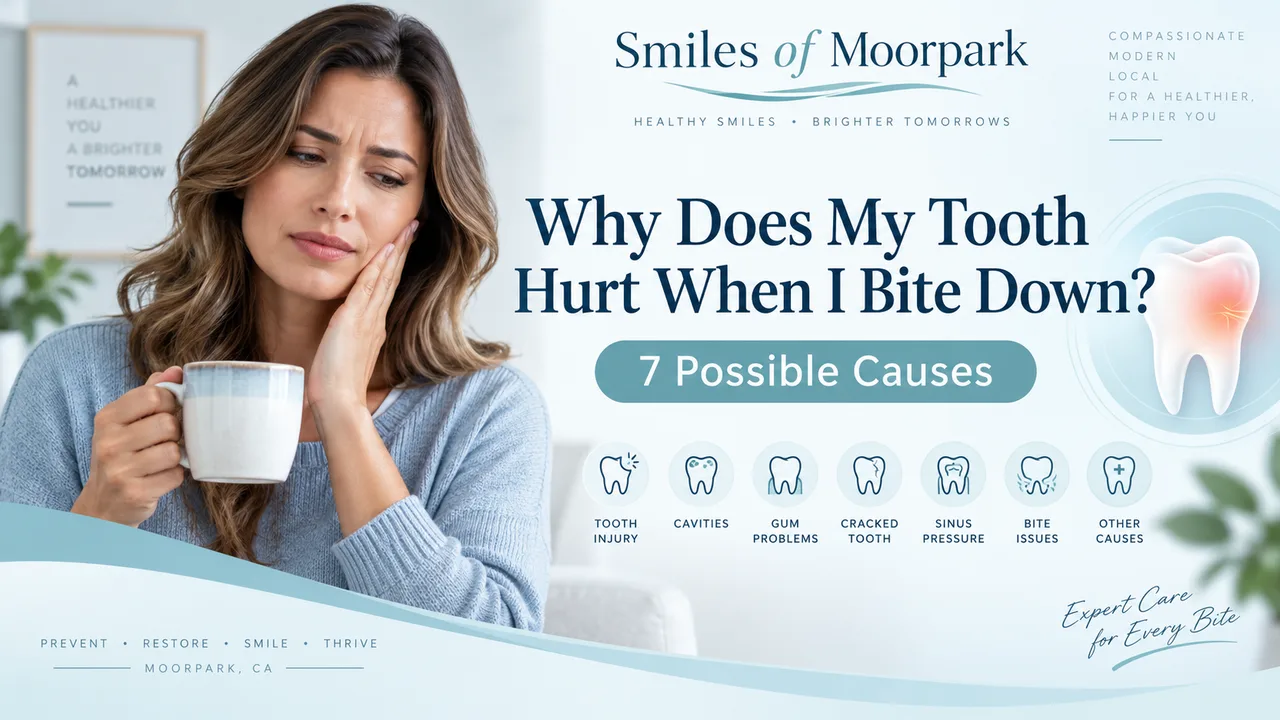
Learn about tooth Pain When Biting Down: 7 Possible Causes with practical guidance from Smiles of Moorpark.
You bite into a sandwich, chew something crunchy, or simply close your teeth together—and suddenly one tooth hurts.
If you’ve been searching “why does my tooth hurt when I bite down?” or “why do I have pain when chewing?”, you’re not alone. Pain that occurs specifically when biting can have several causes, ranging from something as simple as a filling that is slightly too high to a cracked tooth or dental infection that needs prompt attention.
At Smiles of Moorpark, we frequently see patients from Moorpark and surrounding Ventura County communities who tell us, “My tooth feels fine until I bite on it.” That detail can provide an important clue about what may be happening.
Here are seven common reasons a tooth hurts when biting down and how your dentist can determine what is causing the problem.
1. A Cracked Tooth
A cracked tooth is one of the most common reasons for sharp pain when chewing.
Teeth can develop cracks from years of normal use, grinding or clenching, biting hard foods, large old fillings, or previous dental treatment. Sometimes the crack is so small that you cannot see it—even on an X-ray.
A classic cracked-tooth symptom is a sudden, sharp pain when you bite on something, particularly when you release the pressure.
You may also notice:
- Pain that comes and goes
- Sensitivity to cold
- Pain when chewing on one particular side
- Difficulty identifying exactly which tooth hurts
Cracks can range from small enamel fractures that require little or no treatment to deeper fractures that involve the nerve or extend toward the root.
The earlier you evaluate a cracked tooth, the better the chance of protecting and restoring it.
2. A Filling or Crown Is Too High
Did the pain begin shortly after having a filling, crown, onlay, or other dental restoration?
Your bite may simply need an adjustment.
Even a tiny difference in the height of a restoration can cause that tooth to hit before the surrounding teeth when you close your mouth. Over hundreds or thousands of bites each day, that extra pressure can irritate the tissues surrounding the tooth.
Patients often describe the sensation as:
“My tooth feels bruised when I bite.”
Fortunately, when a high filling or crown causes pain when chewing, treatment can sometimes be very simple. Your Moorpark dentist can check the bite with special marking paper and make small adjustments so the teeth come together evenly again.
3. An Inflamed Ligament Around the Tooth
Every tooth is surrounded by a thin structure called the periodontal ligament. Think of it as a microscopic shock absorber between the tooth and the surrounding bone.
If a tooth receives excessive pressure, this ligament can become inflamed.
This may happen because of:
- A high filling or crown
- Grinding or clenching
- Biting something unusually hard
- Trauma to the tooth
- Movement of the tooth
- Infection around the root
When this ligament becomes irritated and swollen, the tooth may feel tender or slightly “higher” than the teeth around it. Biting down can produce a dull, bruised feeling.
Dentists may call this occlusal trauma, but most patients simply notice their tooth hurts when they bite down.
4. A Dental Abscess or Infection
Pain when biting can sometimes come from an infection inside or around a tooth.
When bacteria reach the inner pulp of the tooth—often through a deep cavity, crack, or leaking restoration—the nerve can become severely inflamed or infected. Infection may eventually spread through the root tip into the surrounding tissues.
Symptoms can include:
- Pain when chewing or biting
- Persistent throbbing
- Sensitivity to hot or cold
- Swelling of the gum or face
- A pimple-like bump on the gum
- Bad taste or drainage
- Tenderness when the tooth is tapped
Some dental infections are surprisingly quiet. A tooth may not hurt constantly but may become noticeably uncomfortable when you apply pressure.
If you develop significant facial swelling, fever, difficulty swallowing, difficulty breathing, or rapidly worsening symptoms, seek urgent medical or dental care.
Otherwise, evaluate unexplained tooth pain when biting promptly, because infections generally do not resolve permanently without treating their source.
5. Grinding or Clenching Your Teeth
Do you wake up with sore teeth or jaw muscles? Do several teeth seem tender at the same time?
You may be grinding or clenching your teeth.
Bruxism can place tremendous pressure on teeth and their supporting structures. Some people grind during sleep without realizing it, while others clench throughout the day when concentrating, exercising, driving, or experiencing stress.
Common signs include:
- Tooth tenderness when chewing
- Jaw soreness
- Morning headaches
- Flattened or worn teeth
- Small cracks or chips
- Gumline wear
- Increased tooth sensitivity
Long-term clenching can also contribute to cracked teeth and damaged dental restorations.
Depending on the cause and severity, treatment may include adjusting the bite, repairing damaged teeth, or using a professionally made nightguard to reduce damaging forces.
6. A Cavity
Most people associate cavities with sensitivity to sweets or cold drinks, but tooth decay can also cause pain when chewing.
As a cavity becomes deeper, the tooth may become increasingly sensitive to pressure. Food can also get packed into an area of decay or between two teeth, causing discomfort when you bite.
A small cavity can often be repaired with a relatively conservative filling. However, if decay reaches the nerve, the tooth may require more extensive treatment such as a root canal and crown.
This is one reason we recommend having persistent biting pain examined instead of waiting until the tooth begins hurting constantly.
7. Sinus Pressure
Sometimes the tooth isn’t actually the source of the pain.
The roots of the upper back teeth sit very close to the maxillary sinuses. During a sinus infection, cold, allergy flare-up, or significant congestion, pressure inside the sinuses can create discomfort that feels remarkably similar to a toothache.
Sinus-related dental discomfort typically affects several upper teeth rather than one specific tooth.
You may also notice:
- Nasal congestion
- Pressure around the cheeks or eyes
- Headache
- Pain that changes when bending forward
- Multiple upper teeth feeling sore
However, it isn’t always easy to distinguish sinus pressure from an actual dental problem. If one specific tooth hurts significantly when you bite, a dental exam is a good place to start.
How Does a Dentist Figure Out Why Your Tooth Hurts?
Finding the source of biting pain sometimes requires a little detective work.
At our Moorpark dental office, we may evaluate the tooth using a combination of:
- Digital dental X-rays
- Bite testing
- Cold or temperature testing
- Gentle tapping on individual teeth
- Examining existing fillings and crowns
- Checking your bite
- Looking for cracks
- Evaluating the gums and supporting bone
Not every cracked or inflamed tooth shows an obvious problem on an X-ray, which is why your description of when and how the tooth hurts can be extremely helpful.
When Should You See a Dentist for Pain When Biting?
If you accidentally bite something hard and a tooth feels mildly sore for a few hours, it may settle down on its own.
But if the pain continues, returns repeatedly, or worsens, schedule an examination.
Pay particular attention if:
- One tooth consistently hurts when chewing
- You experience sharp pain when releasing your bite
- A recently treated tooth suddenly feels too high
- You have swelling around the tooth
- Hot or cold sensitivity lingers
- The tooth begins throbbing without being touched
- The pain wakes you at night
Waiting can sometimes turn a relatively straightforward dental problem into a more complicated one.
Tooth Hurts When Biting in Moorpark? We Can Help
If you’re experiencing tooth pain when biting down, pain when chewing, a possible cracked tooth, or another unexpected toothache, finding the cause early can often mean simpler treatment and a better chance of saving the tooth.
At Smiles of Moorpark, we provide comprehensive and emergency dental care in Moorpark, CA, including evaluation of cracked teeth, painful fillings and crowns, dental infections, cavities, and unexplained tooth pain.
You don’t have to wait until a toothache becomes unbearable to have it checked.
If your tooth hurts when you bite down, schedule an evaluation with Smiles of Moorpark so we can identify the cause and discuss the best treatment options.
Need to be seen quickly? Visit our Emergency Dentistry in Moorpark page or call Smiles of Moorpark to schedule an appointment.
Your next step
Explore treatment options or contact our team to discuss your needs.
Your next step
Questions about what’s right for you?
Bring your questions to Smiles of Moorpark. We’ll help you understand your options and plan care around your needs.