Knocked-Out Tooth in Moorpark? What Parents Should Do Right Away
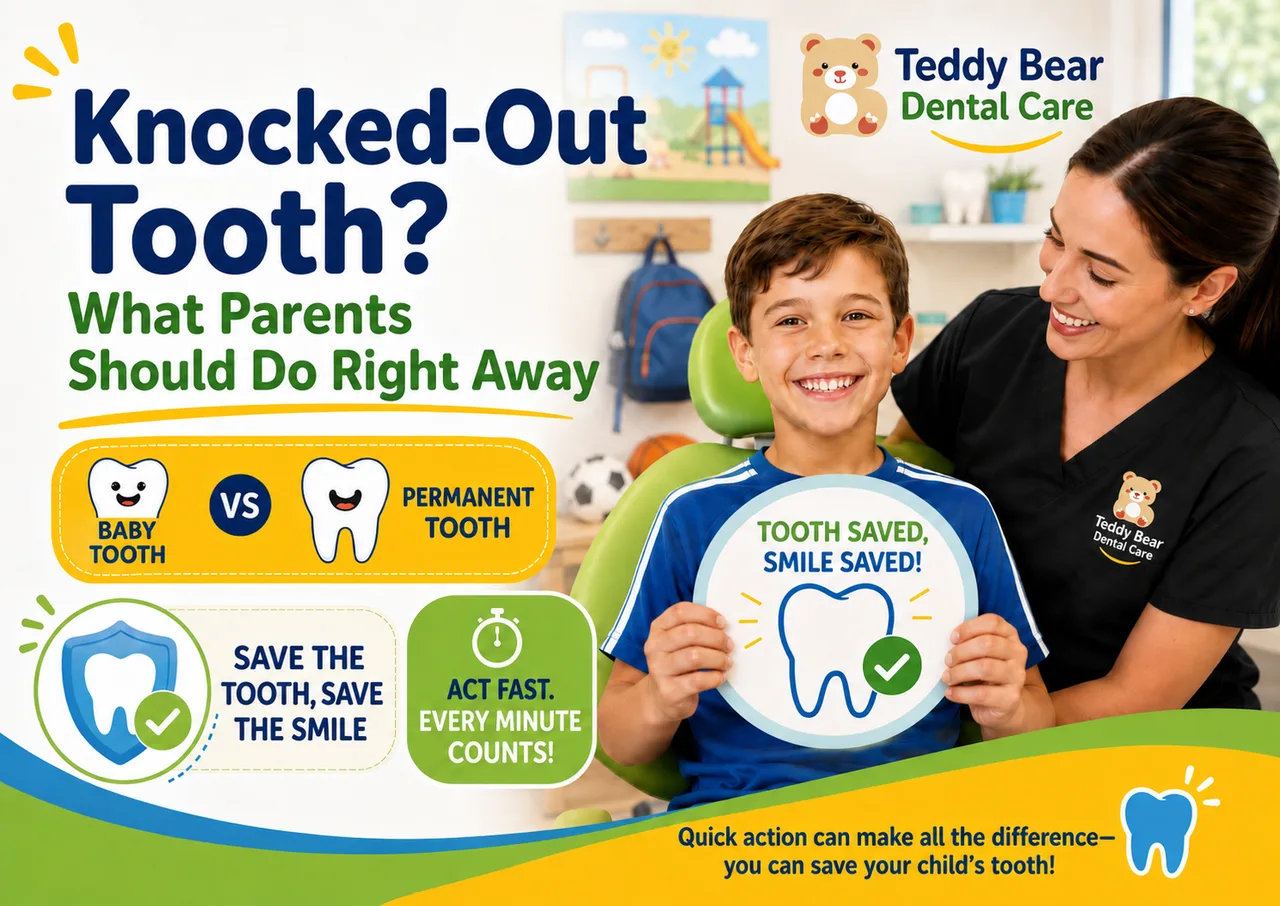
Learn about knocked-Out Tooth: What Moorpark Parents Should Do with practical guidance from Teddy Bear Dental Care.
A fall from the playground. A collision during soccer or basketball. A face-first tumble from a bike or scooter. Dental injuries can happen in seconds—and when a tooth is completely knocked out, what you do during the next few minutes can make a major difference.
For Moorpark parents, proximity matters in this dental emergency. Whether an accident happens during playtime at a daycare, during a hallway obstucle course at home, during recess at Peach Hill Academy, Flory Academy, Mountain Meadows, Walnut Canyon, Arroyo West, or Campus Canyon, or during sports at Chaparral Middle School, Mesa Verde Middle School, or Moorpark High School, you don’t want to spend valuable time driving across Ventura County looking for a dentist.
The most important thing to remember is this:
A knocked-out baby tooth and a knocked-out permanent tooth are handled very differently.
First: Stay Calm and Comfort Your Child.
Use a clean, soft cloth or gauze to wipe any blood. Then evaluate the situation.
Is It a Baby Tooth or a Permanent Tooth?
This question determines what you should do next.
Children typically begin losing their front baby teeth around age six, when permanent teeth begin appearing. During the mixed-dentition years, it isn’t always obvious to a parent, teacher, coach, or school nurse whether an injured tooth is primary or permanent.
If you’re not sure, call a dentist immediately and explain your child’s age, which tooth was lost, and what happened. Do not automatically push the tooth back into the socket unless you are confident it is a permanent tooth.
Why? Because a knocked-out permanent tooth should usually be replanted as quickly as possible, while a knocked-out baby tooth should never be replanted. The International Association of Dental Traumatology guidelines endorsed by the American Academy of Pediatric Dentistry specifically advise against replanting primary teeth.
If a BABY Tooth Is Knocked Out
If your toddler or young child completely knocks out a baby tooth, do not put it back into the socket.
A permanent tooth is developing underneath that baby tooth. Reinserting the baby tooth could injure the developing permanent tooth.
Instead, find the tooth if you can and gently control bleeding by having your child bite on clean gauze. A cold compress placed on the outside of the lip or cheek can help reduce swelling.
Then call your child’s dentist or pediatric dental office. Even though the dentist will not reinsert the tooth, your child should still be evaluated. The dentist needs to make sure that there isn’t an injury to the surrounding teeth, bone, gums, or developing permanent tooth.
It’s also important to determine whether the tooth actually came out. Occasionally, a tooth that appears to be missing has instead been pushed upward into the gum. If you can’t locate the tooth, don’t assume that it simply fell somewhere on the playground.
If your child suffered a significant blow to the head, lost consciousness, seems confused, has difficulty breathing, or has other concerning symptoms, seek medical attention immediately. The AAPD recommends medical evaluation when dental trauma is accompanied by loss of consciousness, neurological symptoms, or other major medical concerns.
If a PERMANENT Tooth Is Knocked Out: Move Quickly
A completely knocked-out permanent tooth—called an avulsed tooth—is a true dental emergency.
This is one of the rare situations in dentistry where minutes really do matter.
The cells covering the root of the tooth begin drying out very quickly once the tooth leaves the mouth. International dental-trauma guidelines note that minimizing dry time is critical; after about 30 minutes, most periodontal ligament cells on the root may no longer be viable.
That does not mean the tooth is hopeless after 30 minutes. Dentists may still attempt to save a tooth even after a longer period outside the mouth. But the sooner the tooth is properly handled and treated, the better.
The American Association of Endodontists advises reaching a dentist or endodontist within approximately 30 minutes whenever possible.
What to Do With a Knocked-Out Permanent Tooth
If you are confident that the tooth is permanent, follow these steps:
- Find the tooth immediately. Pick it up only by the crown—the white part you normally see in the mouth. Never hold it by the root.
- If the tooth is dirty, rinse it very gently. Do not scrub, scrape, disinfect, or try to remove tissue from the root. Rinse gently with cold milk, saline, eye drops, or the patient’s saliva, following dental-trauma guidelines.
- If possible, place the permanent tooth gently back into its socket. Make sure it faces the correct direction, and don’t force it. The child can gently bite on clean gauze to help hold it in place. Immediate replantation offers the best chance of preserving the tooth.
- If you cannot reinsert it, keep it moist. Place it in cold milk or a tooth-preservation solution, such asHank’s Balanced Salt Solution, if available. Saline is another option. For children, milk is often the simplest and safest choice. Don't wrap the tooth in a tissue or paper towel and let it dry.
- Head to the nearest dentist who can treat the injury immediately. Call the office while you’re on the way so the dental team knows you’re coming.
Don’t Spend an Hour Looking for the “Perfect” Dentist
This is where local care becomes especially important.
Imagine your child knocks out a permanent front tooth during recess at Peach Hill or Mountain Meadows. Or your teenager takes an elbow to the mouth during basketball practice at Chaparral, Mesa Verde, or Moorpark High.
This isn’t the time to drive 30 or 45 minutes to a dentist in another community simply because that’s where your family has gone in the past.
Call the closest dental office that can handle the emergency.
The goal is to evaluate the tooth, replant it if needed, stabilize it, and take X-rays as quickly as possible.
Once the dentist returns the permanent tooth to its socket, they will typically evaluate its position and the surrounding bone and may temporarily stabilize it with a flexible dental splint. Follow-up is extremely important because complications can develop later even when the tooth initially looks perfectly normal.
What If the Tooth Is Chipped, Loose, or Pushed Out of Position—but Not Completely Knocked Out?
That’s still a dental emergency.
A tooth doesn’t have to be lying on the playground to have suffered a serious injury. Teeth can be pushed inward, sideways, or partially out of their sockets. They can also fracture below the gumline.
Don’t try to force a displaced tooth into position yourself. Contact a dentist promptly so they can examine the injury and take X-rays when appropriate.
And if you find a broken piece of tooth, bring it with you.
Sports Parents: Consider a Mouthguard
Many dental injuries happen during sports—not only football and hockey, but also basketball, baseball, soccer, lacrosse, skateboarding, and other activities with falls or collisions.
For children and teens involved in sports, a properly fitting mouthguard can significantly reduce the chance of serious dental trauma.
This is especially worth considering once permanent front teeth have erupted. Those are the teeth we especially want to protect because, unlike baby teeth, there isn’t another set waiting underneath them.
Different sports require different types of sportsguards. To learn more about the right kind of sportsguard for your child, read this article.
A Simple Rule Moorpark Parents Can Remember
When you’re standing on a playground or athletic field with a frightened child, you aren’t going to remember an entire dental textbook.
Remember this instead:
Baby tooth out? Don’t put it back. Call the dentist.
Permanent tooth out? Pick it up by the crown, keep the root moist, replant it if you can do so safely, and get to a dentist immediately.
And if you aren’t sure whether it’s a baby tooth or a permanent tooth, call while you’re still at the school, park, or sports field.
At Teddy Bear Dental Care in Moorpark, we want parents, teachers, coaches, and school staff to know what to do before an accident ever happens. With schools including Arroyo West, Flory Academy, Mountain Meadows, Peach Hill, Walnut Canyon, Campus Canyon, Chaparral, Mesa Verde, and Moorpark High all right here in our community, having a local dental emergency plan can save more than driving time—it may help save a permanent tooth.
Tooth Knocked Out in Moorpark? Call Right Away
If your child has suffered a dental injury, don’t wait to see whether it feels better tomorrow. Call Teddy Bear Dental Care as soon as possible and tell us that your child has experienced dental trauma so that we can quickly triage the situation and take the steps needed to save a permanent tooth.
When a permanent tooth has been knocked out, every minute counts.
Your next step
Explore children’s dental care or contact our team to discuss your needs.
Your next step
Let’s talk about your child’s smile.
Bring your questions to Smiles of Moorpark. We’ll help you understand your options and plan care around your needs.