Dental Trends to Ditch: When Viral Smile Hacks Do More Harm Than Good
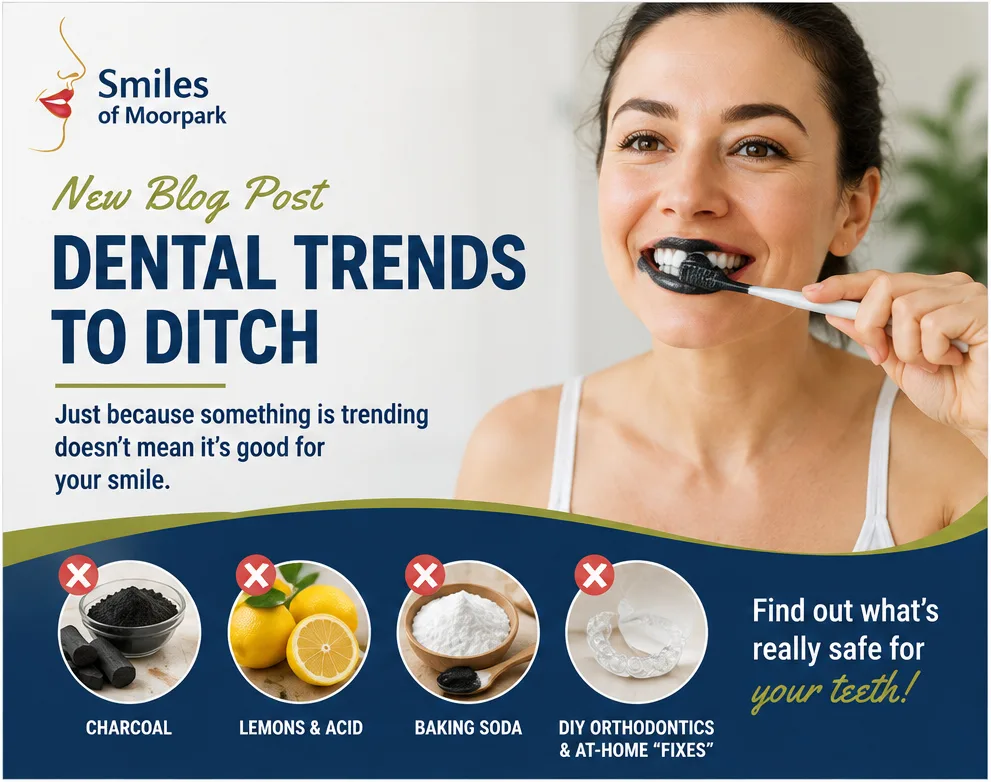
Learn about dental Trends to Avoid: Safer Smile Care with practical guidance from Smiles of Moorpark.
Social media can be a great place to discover recipes, beauty tips, and clever hacks. But when it comes to your teeth, a viral video is not the same thing as dental science.
Just because something is trending—or has millions of views—doesn't mean it is biologically sound.
Teeth are not hair or fingernails. Enamel doesn't simply grow back after it is removed, and teeth cannot always be moved, filed, bleached, or covered without consequences. The American Dental Association warns that some popular online dental trends range from ineffective to potentially harmful.
That doesn't mean you should feel embarrassed if you've tried one. Most dental hacks become popular for understandable reasons: people want a whiter, straighter, more attractive smile without spending a fortune.
The problem is that the "cheap shortcut" can become the expensive option once you need to repair the damage.
Here are some dental trends worth reconsidering.
1. Charcoal Toothpaste and Charcoal Toothbrushes
Activated charcoal is tailor-made for social media. Black toothpaste makes a dramatic video, and teeth may appear brighter immediately afterward because surface stains have been scrubbed away.
But scrubbing harder isn't the same as whitening better.
Charcoal products can be highly abrasive. Repeated abrasion may gradually wear away enamel, exposing the naturally more yellow dentin underneath. Ironically, a product being used to make teeth look whiter can eventually make them appear more yellow. The ADA also notes insufficient evidence that charcoal dental products are safe and effective for whitening.
The concern isn't whether you used charcoal toothpaste once. It is what happens when an abrasive product becomes your everyday toothpaste for months or years.
Better option: Choose a fluoride toothpaste—preferably one with the ADA Seal—and ask your dentist about whitening if tooth color is your main concern.
2. Lemon Juice, Apple Cider Vinegar and Other Acidic Whitening Hacks
Lemons make things brighter in the kitchen, so it's easy to understand how the idea of lemon whitening got started.
Unfortunately, teeth aren't countertops.
Lemon juice, oranges, vinegar, and other acidic ingredients can soften and erode enamel when left on teeth or rubbed on them repeatedly. Enamel is the protective outer layer that helps shield teeth from cavities and sensitivity. Once you lose significant enamel, you can't simply put it back.
Combining acid with an abrasive substance—such as lemon juice followed by aggressive brushing or baking soda—can be particularly unkind to enamel.
Better option: If you want whiter teeth, use products designed and tested specifically for dental whitening rather than household acids.
3. Baking Soda Whitening Concoctions
Baking soda has become the base ingredient in countless DIY recipes: baking soda with lemon, baking soda with peroxide, baking soda with strawberries, and almost anything else someone can put into a 30-second video.
This one requires a little nuance.
Baking soda itself is used in some professionally formulated toothpastes. The problem is assuming that because an ingredient can be appropriate in a tested dental product, mixing it in your kitchen automatically makes it equally safe.
Homemade combinations may be too abrasive or may combine baking soda with acids or improperly concentrated peroxide. The ADA specifically cautions against overly abrasive whitening scrubs because excessive abrasion can wear enamel and expose yellow dentin.
Better option: Buy a toothpaste or whitening product formulated for teeth instead of becoming your own cosmetic chemist.
4. The Banana Peel Whitening Trick
You've probably seen this one: rub the inside of a banana peel across your teeth and supposedly potassium, magnesium, or other minerals will create a dramatically whiter smile.
It sounds pleasantly natural. Viral videos promoting various banana peel tricks also promise help with weight loss, improved eyesight, and lower cholesterol.
Unfortunately, there isn't good evidence that rubbing fruit on your teeth meaningfully whitens enamel. The ADA also cautions that kitchen-based "natural whitening" methods aren't necessarily effective just because the ingredients are natural.
Banana peels are certainly less concerning than repeatedly bathing teeth in lemon juice, but they aren't a substitute for proven whitening.
If you like bananas, eat the banana.
5. DIY Orthodontics and At-Home Tooth Movement
This is where an online dental trend can go from questionable to genuinely dangerous.
People have attempted to close spaces with rubber bands, move teeth with homemade appliances, and straighten teeth using systems that provide little or no in-person professional supervision.
Teeth are attached to bone through living tissues. Orthodontics isn't simply pushing a tooth from Point A to Point B. Your dentist or orthodontist evaluates your roots, bone, gums, bite, and the relationship between your upper and lower jaws before deciding how teeth should move.
The American Association of Orthodontists warns that poorly supervised at-home orthodontic treatment can cause potentially irreversible problems, including tooth or gum loss and unwanted changes to the bite.
Better option: If cost is the concern, tell your dentist. Depending on what you want to change, there may be several treatment approaches, payment options, or a more limited treatment plan.
6. Snap-On, At-Home and DIY Veneers
The promise is incredibly appealing: order a new smile online, snap it over your existing teeth, and instantly cover spaces, crooked teeth, and discoloration.
The problem is what's happening underneath.
A cosmetic cover does not diagnose decay, gum disease, bite problems, infections, or cracked teeth. Poorly fitting coverings can also interfere with the bite or trap plaque and food against teeth.
Another growing social-media trend involves so-called "veneer technicians" who perform dental procedures without a dental license. The ADA has specifically warned about the potential for irreversible damage, infections, nerve injury, and other complications when veneer procedures are performed without appropriate dental supervision.
Veneers can create beautiful transformations—but they need to begin with diagnosis and careful planning.
7. Filing Your Own Teeth
Yes, this has become a social-media trend too.
People use nail files or small tools to shorten uneven teeth, smooth edges, or create a more symmetrical smile.
The immediate problem is simple: you don't get a second layer of enamel once you've filed through the first one.
Removing too much tooth structure can cause sensitivity, increase susceptibility to decay, alter the bite, and potentially contribute to cracks or fractures. The American Association of Orthodontists warns that DIY filing can cause permanent, costly damage.
A dentist can sometimes reshape a tooth safely by removing a very controlled amount of enamel, or may recommend bonding instead so tooth structure is added rather than removed.
8. Oil Pulling as a Replacement for Dental Care
Swishing coconut or another oil around your mouth has been promoted for everything from whitening teeth to treating gum disease.
If you enjoy oil pulling, it doesn't necessarily need to disappear from your life. The bigger issue is using it instead of brushing, flossing, or treating an infection.
The ADA notes that reliable evidence does not show oil pulling whitens teeth, and dental experts caution against allowing it to replace treatments known to prevent or treat dental disease.
Think of it as optional—not treatment.
"But Going to the Dentist Costs More"
At first glance, sometimes it does.
A $12 internet whitening hack certainly sounds cheaper than professional whitening. A snap-on veneer may look less expensive than cosmetic dentistry. An unsupervised orthodontic product may appear cheaper than Invisalign or braces.
But there's another number worth considering:
What will it cost if the shortcut damages healthy teeth, gums, and supporting bone?
Enamel erosion may eventually require bonding, veneers, or crowns. Poorly controlled tooth movement can create bite problems or damage gums and supporting bone. Aggressive DIY filing cannot simply be reversed. An untreated cavity hidden beneath a cosmetic covering can continue getting larger.
Professional dental care isn't expensive simply because you're paying someone to perform a procedure. You're paying for the examination, diagnosis, X-rays when appropriate, treatment planning, materials, sterilization, professional judgment, and the ability to recognize when not to perform a procedure.
Sometimes the most cost-effective dental treatment is the one that prevents you from needing a much bigger treatment later.
Before You Try the Next Viral Dental Hack…
You don't have to reject everything you see online.
Just ask a few questions:
Does this remove enamel? Does it use acid or an abrasive? Does it move teeth? Does it permanently alter a tooth? Could it hide an underlying dental problem?
If the answer to any of those questions is yes, talk to your dentist first.
And don't worry about being judged for asking. Bring in the video. Show us the product. Let us know what you're hoping to accomplish.
There may be a safer way to get you there.
Trends come and go. Your teeth need to last a lifetime.
Your next step
Explore treatment options or contact our team to discuss your needs.
Your next step
Questions about what’s right for you?
Bring your questions to Smiles of Moorpark. We’ll help you understand your options and plan care around your needs.