The “Dental Facelift”: How Restoring Worn Teeth Can Help Rejuvenate Your Smile—and Your Face
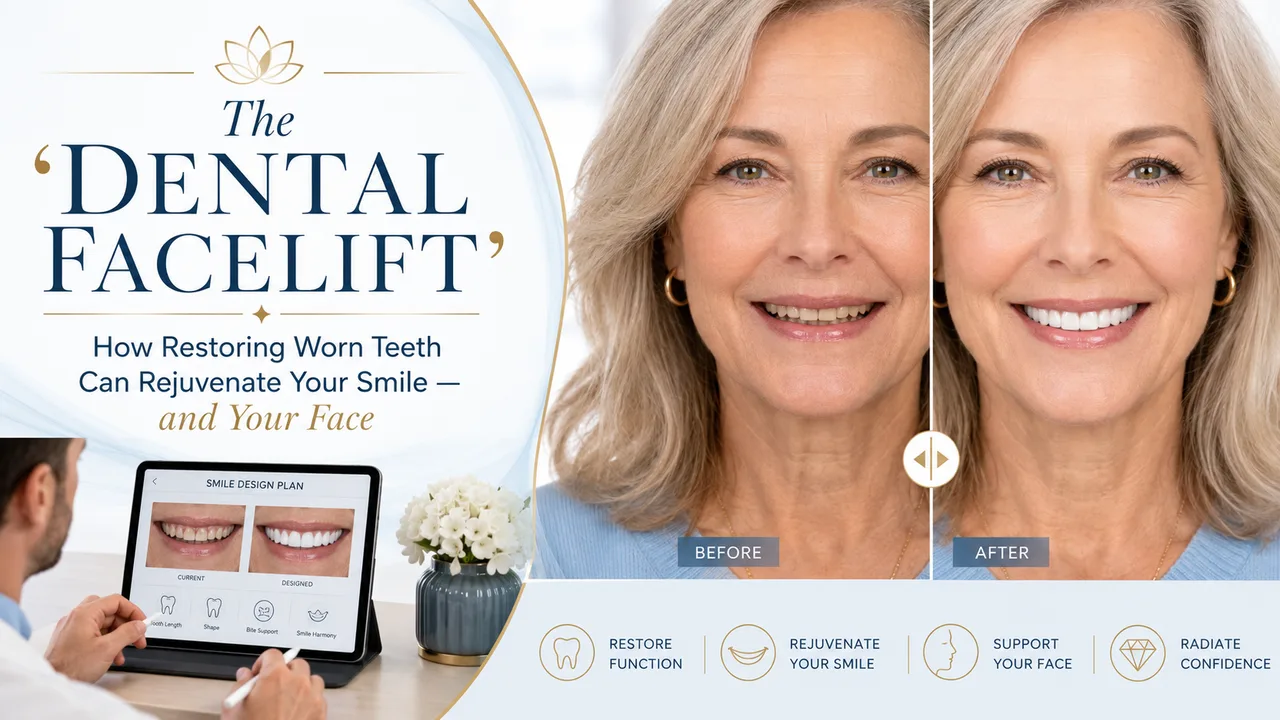
Learn about worn Teeth and the Dental Facelift with practical guidance from Smiles of Moorpark.
When people think about looking younger, they often think about skin care, Botox, fillers, or a surgical facelift. But there is another part of the face that can dramatically influence how youthful—or aged—we appear: our teeth and bite.
Over many years, teeth can gradually shorten from grinding, clenching, acid erosion, bite problems, or cumulative wear. In some patients, severe tooth wear contributes to a loss of the lower face's natural height and support. Restoring that lost tooth structure can sometimes create a surprisingly rejuvenating effect.
This type of comprehensive restorative treatment is sometimes informally called a “dental facelift.”
It is not actually a facelift, and dentistry cannot tighten loose skin or replace cosmetic surgery. Instead, the concept involves rebuilding worn teeth, restoring proper tooth proportions and, when appropriate, increasing the vertical dimension of occlusion—the height of the lower face when the teeth come together.
The result can be much more than a beautiful new smile. In carefully selected patients, restoring lost dental height may also improve lip support, facial proportions, and the appearance of some of the folds around the mouth. Research has demonstrated measurable changes in lower facial height and facial appearance after rehabilitation of worn teeth.
Why Do Worn Teeth Make the Face Look Older?
Your teeth are part of the structural framework of the lower third of your face.
When the upper and lower teeth come together, their height helps determine the distance between your nose and chin. Dentists call this relationship the vertical dimension of occlusion, or VDO.
Imagine the teeth as small architectural supports within the lower face. If you lose enough tooth structure, the relationship between the upper and lower jaws can change.
The chin may appear closer to the nose. The lips can look less supported. The corners of the mouth may appear to turn downward. The lower third of the face may look more compressed.
This doesn’t happen to everyone with tooth wear. The body can compensate for gradual wear through changes in the teeth and supporting structures, so worn teeth don't automatically mean someone has lost vertical dimension. Research has specifically demonstrated this variability.
But in patients with significant wear and true loss of vertical dimension, rebuilding the teeth can make a noticeable difference.
What Happens to the Nasolabial Folds and Marionette Lines?
Two areas often associated with facial aging are the nasolabial folds and marionette lines.
Nasolabial folds extend from the sides of the nose toward the corners of the mouth. Marionette lines extend downward from the corners of the mouth toward the chin.
These lines develop for many reasons. Normal aging changes the skin, facial fat, muscles, connective tissues, and underlying facial skeleton. Dental changes are only one piece of that process.
However, reduced support in the lower facial third may make the tissues around the mouth appear more compressed or folded.
Think of what happens when an accordion closes. As the distance between the top and bottom decreases, the material between them folds.
The comparison isn’t perfect, but it helps explain why a collapsed bite can accentuate creases around the mouth.
If appropriate dental treatment restores some of the lost vertical height, the lower face may become slightly more elongated, and the lips and surrounding tissues may receive better support.
Studies evaluating increases in vertical dimension have documented changes in lower facial height, lip dimensions, and other soft-tissue relationships.
That does not mean crowns or veneers erase wrinkles. They don’t.
But restoring the dental foundation underneath the lower face can sometimes soften the compressed appearance and “iron out” the lines around the mouth that accompany severe tooth wear.
What Causes Teeth to Become Shorter?
Significant tooth wear can have many causes.
One of the most common is bruxism—grinding or clenching. Years of heavy contact can gradually flatten the biting surfaces and shorten the front teeth.
Acid erosion can also remove enamel. This may come from dietary acids, frequent acidic beverages, gastric reflux, eating disorders, or other sources.
Missing teeth can change how forces are distributed throughout the mouth, causing the remaining teeth to carry more stress.
Other patients have a naturally powerful bite or a pattern of tooth contact that accelerates wear.
Often, several factors occur together.
The important question isn’t simply, “Are my teeth worn?”
It is:
“Why are they worn, and has that wear changed my bite?”
That distinction matters before a smile makeover begins.
What Does a “Dental Facelift” Actually Involve?
No single procedure is called a dental facelift.
Treatment is customized to the individual patient and may involve veneers, crowns, onlays, bonding, implants, orthodontics, or a combination of treatments.
The objective is to rebuild teeth into healthier proportions while creating a stable, comfortable bite.
For someone with severely worn teeth, the dentist may determine that several millimeters of tooth height can safely be restored.
That sounds like a tiny amount.
Facially, however, millimeters matter.
Research involving patients treated for tooth wear found measurable increases in lower facial height following restoration of vertical dimension, together with significant improvements in patients’ perception of their appearance.
Another clinical study found that increasing vertical dimension can alter lower facial proportions, including lip height and the nasolabial angle.
That helps explain why a properly planned full-mouth reconstruction can sometimes create a change that people notice without immediately understanding why.
They may simply say:
“You look younger.”
The Smile Changes, Too
The facial effect is only part of the transformation.
Worn teeth often become shorter, flatter, and darker because enamel has been gradually lost.
When they are rebuilt, the dentist can restore the length and contours the teeth once had—or create proportions that better complement the patient’s face.
The new smile may look:
- Fuller
- Brighter
- More symmetrical
- Less worn
- More youthful
- Better supported by the lips
Restoring front tooth length can also dramatically change how much tooth shows when someone smiles and speaks.
This is why comprehensive restorative dentistry can create such a different effect from simply whitening the teeth.
Planning Is Everything
A treatment this comprehensive should never begin with a simple decision to make the teeth longer.
Dentists must carefully evaluate the correct vertical dimension.
Dentists may use photographs, digital scans, X-rays, bite analysis, facial measurements, models and digital smile design to determine what is appropriate.
Modern digital techniques can even help dentists evaluate changes in facial appearance at different proposed bite heights before definitive treatment. Recent clinical reports have used 3-D facial scanning and digital mock-ups to evaluate these changes during treatment planning.
Often, a provisional or mock-up stage lets the patient and dentist evaluate the new tooth length and bite before final restorations are made.
How does the smile look?
How does the face look?
Can the patient speak naturally?
Does the bite feel comfortable?
Are the tooth proportions right?
Cosmetic dentists work out these details before fabricating the final veneers.
Dentistry First, Facial Rejuvenation Second
The term “dental facelift” is catchy, but the distinction is important.
The purpose of rebuilding severely worn teeth is first to restore health, function, tooth structure, and a stable bite.
A more youthful facial appearance can be an additional benefit for the right patient.
It is also important to have realistic expectations. Dental treatment cannot eliminate every nasolabial fold or marionette line because facial aging involves skin, muscle, fat, bone, genetics, and dental support.
But when tooth wear has contributed to a shortened or collapsed lower facial appearance, restoring what has been lost can change far more than the teeth.
Could Your Teeth Be Aging Your Smile?
If your teeth look considerably shorter than they once did, your bite seems to have changed, your front teeth appear increasingly worn, or the lower part of your face looks more compressed than it used to, it may be worth having your bite evaluated.
And if you are considering veneers or a cosmetic smile makeover, the conversation shouldn’t begin with choosing a tooth shade.
It should begin with understanding the entire smile, the bite, and the face.
The most beautiful transformations don’t simply create whiter teeth.
They restore proportion.
They restore function.
They restore support.
And sometimes, by rebuilding a smile that has gradually worn away over decades, we can help reveal a more youthful version of the face that was there all along.
Your next step
Explore treatment options or contact our team to discuss your needs.
Your next step
Questions about what’s right for you?
Bring your questions to Smiles of Moorpark. We’ll help you understand your options and plan care around your needs.